LID: Site Assessment and Bioretention Design
**All courses will include both the classroom and field activity portions presented through a remote, interactive, live-stream format. When allowed per state restrictions, we will resume an in-person field activity portion of the course, this will be outside with enough room for social distancing.  You will be required to have PPE's, face mask, and follow state/local construction guidelines, we will notify you via email of those requirements.  You will need a computer and a reliable internet connection.   If you would like more information or have any questions, please contact us via email or phone 425 270 3274. 


Low-Impact Development Installations are the emerging standard for community planning and construction. Successful LID installations are planned, executed, and maintained by an informed team. Our LID Workshop offers your entire team a deeper understanding of their role in the success of LIDs in your projects. Learn the latest on LID installations and maintenance, including a live-stream field activity demonstrating the Do’s and Don’ts.

This is a two-day intermediate level course for engineers, planners, landscape architects, local jurisdiction staff, developers, construction managers, and allied disciplines that plan, design, review, and build bioretention and rain garden projects. The course covers two subject areas:

  1. Fundamental strategies and techniques to assess soils and other site characteristics to effectively and efficiently plan and develop a site layout using LID principles and practices. Specifically, the workshop focuses on the most effective techniques for soils and hydrology exploration, as well as the best timing and location for those tools.
  2. Current design guidelines, construction details, flow control, water-quality treatment performance, and practical experience necessary to properly design and build bioretention systems and rain gardens.

Participants will:

  • Understand the overall site assessment (e.g. soil suitability for infiltration and on-site hydrology) with particular attention to identify LID opportunities during the design process.
  • Gain an intermediate level knowledge necessary for proper entry-level design and implementation of bioretention systems in residential and commercial settings (new and retrofit).
  • Learn skills necessary for basic site assessment and locating bioretention areas in residential and commercial settings.
  • Learn practical skills necessary for construction of basic bioretention systems.
Intended audience

This Course will be beneficial to municipal workers and state agencies, including: engineers, planners, landscape architects, local jurisdiction staff, developers, construction managers, and allied disciplines that plan, design, review, and build bioretention and rain garden projects.

CEUs
1.60
Course Topics

The course covers two subject areas:

  1. Fundamental strategies and techniques to assess soils and other site characteristics to effectively and efficiently plan and develop a site layout using LID principles and practices. Specifically, the workshop focuses on the most effective techniques for soils and hydrology exploration, as well as the best timing and location for those tools.
  2. Current design guidelines, construction details, flow control, water-quality treatment performance, and practical experience necessary to properly design and build bioretention systems and rain gardens.


Course Materials

Attendees will receive a course workbook containing workshop proceedings and reference material.

What to bring

PPE for field portion, if coming in person

Persuasive Online and Written Presentations: When Information is Not Enough

**Note - This course is offered exclusively using live stream remote attendance. You will need a computer and an internet connection. We will continue to monitor the situation surrounding COVID-19 closely.  When it is deemed safe to reconvene group gatherings, we will resume our in-person class offering as usual.  If you would like more information or have any questions, please contact us via email or phone 425 270 3274.


How to Get Distracted Audiences to Stop, Pay Attention, and Act

Being persuasive has always been important because it helps people act despite mental roadblocks.  Online presenting is more important than ever because presentations are increasingly moving to the Internet.  And it is hard to capture the attention of busy people because they are, well, too busy to focus for long on your message.  This course teaches simple, but effective tools to deliver your message, make it stick, and, in so doing, create positive change. 

What are the Benefits From this Course?

Every time you present, you are managing two reputations—yours and your organizations. Make sure your presentations enhance these. The person whose message sounds like the most sensible way forward will define the future.  Make sure that person is you.  Whether presenting to clients, employees, stakeholders, or the media, you need to communicate with credibility.  This course will offer tools to deliver your information convincingly and with this confidence.

We all have to deal with ‘difficult’ audiences.  Make sure you gain the edge in challenging situations even when:

  • There is mistrust and anger in the room,
  • There is technical complexity that impedes understanding, and
  • The Internet gets in the way and keeps your audience from being fully engaged

This highly interactive workshop develops skills for making prepared and impromptu presentations.  We take on the challenge of presenting in situations that may be controversial or highly charged.  And we cover online presenting and presenting with brief written documents. We focus on communication skills for occasions when there is time to prepare in advance, such as a formal briefing or prepared speech.  And we focus on skills for making impromptu presentations such as handling questions and media interviews. This course will focus on oral and brief written communications for occasions when you have to get your message across effectively and quickly but remain persuasive.

This course covers:

  • Analyzing why an audience is resistant to your message—what brain researchers and risk managers have to teach us.
  • Designing a way to deal with resistance points—developing messaging that responds to criticism you might encounter.
  • Designing the delivery of your communication—whether presenting in writing or orally, when you need to deliver recommendations, not just information.
  • Models for persuasive oral remarks.
  • Models for persuasive written briefings.
  • Models for when you do not have time to prepare ahead, such as media interviews and question/answer sessions.
  • Transforming conflict conversations into a respectful and more positive discussion using tips and techniques that mediators use.
  • Capturing attention and delivering motivational remarks using tips that professional speakers use.


Who This Course is For?

This course is suitable for a wide variety of professionals including environmental risk managers, regulators, public involvement managers, remediation project managers, program managers, technical experts, engineers, scientists, health and safety personnel, natural resource personnel, environmental planners, public affairs officers, attorneys, and others who are called upon to communicate in difficult environments and who need to persuade when doing so.


What is Unique in this Course?

We improve the usual approach to audience analysis (demographics, topic familiarity, etc.) by considering research findings on how the brain processes decisions and makes people skeptical and resistant to new courses of action.  Then we introduce multiple planning models to design a persuasive presentation, including techniques used by professional motivational speakers.  We look specifically at communicating when there is a lot of distrust and conflict in the audience.  And we cover how to handle a media interview and models for impromptu presenting. 

Participants working in teams prepare and deliver several presentations during the workshop and receive instructor and peer coaching on how to improve.  The goal of this course is to move beyond the notion that persuasive presenting is about delivering information.  Persuasive presenting is a carefully designed communication process designed to inspire forward movement on your issues.  


What Can You Expect in this Workshop?

Teaching Model:  We use a Tell Show Do Teach-Back Model

  • Tell: We present what we know about the skills being taught.
  • Show: We demonstrate how the skills are applied through lectures, exercises, facilitated discussion, etc.
  • Do: We have participants practice the skills using team assignments, role plays, mock activities, etc.
  • Teach-Back: We wrap up topics with peer-to-peer and instructor advice on how to apply the new skills in the real world.

How We Present this Material:  We use discussion, exercises, lecture, and mock exercises combining student and instructor experiences to collaboratively create dynamic, fun, and highly interactive training.   But learning is not complete until there is application.  Participants discuss how they can transform the course content into a real-world application after the course. 


Can the Course be Customized for your Organization?

If your need is to train inside your organization we can increase relevance and value by modifying the content to match your audience and your specific goals for the event.  While this program is designed as a specific, interactive training session, we can provide anything from a one-hour keynote presentation to the full event and we emphasize the topics that you think are most valuable.


Testimonials

"Instructor is clearly skilled in the field and adept at conveying the material." J. Corwin

"Michael was knowledgeable, entertaining, and struck a great balance between presenting to us and hands-on participation. I enjoyed this class!" Ian S.

"Good variety of topics & tools, so even if one tool doesn't seem applicable, others will be. Good participation methods for attendees." Anonymous

"Great instructor! Lots of great information delivered well!" C. Marchand


In reality, good persuasion is all about helping people. There are a lot of reasons why being persuasive is an important skill for a professional, but most importantly persuasion helps people take beneficial action despite the mental roadblocks that get in the way.  The bottom line is that people won’t buy into your vision for the future unless you persuade them.


Intended audience

This course is suitable for a wide variety of professionals including environmental risk managers, regulators, public involvement managers, remediation project managers, program managers, technical experts, engineers, scientists, health and safety personnel, natural resource personnel, environmental planners, public affairs officers, attorneys, and others who are called upon to communicate in difficult environments and who need to persuade when doing so.

Course Topics

Day 1 focuses on skills for when you have time to prepare and have greater control over the presentation setting:

  • Having open discussions on controversial topics such as environmental risk management.
  • The reasons why environmental risk and other controversies present unique and difficult communication challenges.
  • Audience analysis.
  • Developing effective formal briefings (using three different models).
  • Writing effective one-page briefing sheets.
  • Delivering a motivational speech when you need to inspire action.
  • Practice sessions reinforcing skills learned.
  • Debrief the lessons learned to use after the course.

Day 2 focuses on skills for occasions when you have to speak 'in the moment' and when presenting online.

  • Online impediments that keep audiences from engaging and what you can do about these.
  • Five models for handling impromptu speaking, especially when yours is a ‘hot’ topic.
  • Diagnosing and redirecting criticism to a positive dialogue.
  • Handling the media interview.
  • PowerPoint® and other media skills that work.
  • Stagecraft and non-verbals that professional speakers use.
  • Practice sessions reinforcing the skills learned.
  • Debrief the lessons learned to use after the course.
Course Materials

Attendees will receive a course workbook containing workshop proceedings and reference material.

What to bring

This course will be held in a virtual classroom as a remote, interactive, live-stream presentation.  Please make sure to provide NWETC with the best mailing address for us to get the course materials to you. 

PFOS, PFAS, PFOA, and Emerging Contaminants

**If this course has Remote Live Attendance -- USA as the location, it is a live stream remote course. You will need a computer and an internet connection.

**If this course has a city and state as the location, we will be attempting to hold the course in-person at the listed location with course times listed in the host city's time zone; however, due to gathering restrictions and health concerns, NWETC reserves the right to convert this course to a live remote streaming course. If you would like more information or have any questions, please contact us via email or phone 425 270 3274. 

In this 2-day PFAS in Groundwater & Emerging Contaminants course you will learn how to apply scientific and legal considerations to sites contaminated with per- and polyfluoroalkyl substances (PFAS). Per- and polyfluoroalkyl substances (PFAS) are a group of man-made chemicals that includes PFOA, PFOS, GenX, and many other chemicals, which are very persistent in the environment and in the human body. There is evidence that exposure to PFAS can lead to adverse human health effects. PFAS have been manufactured and used in a variety of industries around the globe, including in the United States since the 1940s and their chemistry creates unique challenges in water treatment and remediation. The fate, transport, and chemical transformations of most PFAS in the environment are still unknown and are areas of active scientific research.

We will explore the topics of PFOS, PFAS, PFOA, and emerging contaminants related to soil and groundwater remediation.  Over the past few years, several agencies and organizations have released strategies and recommendations related to emerging contaminants.  In general, emerging contaminants are ones for which incomplete toxicity data exists or for which new data has been released.  Emerging contaminants could also be from a new source or have a newly recognized exposure pathway or lower detection limit. 

This workshop will keep you up-to-date on the topic of emerging contaminants and will give you an understanding of how U.S. agencies such as EPA and DOE are working to develop approaches for dealing with emerging contaminants.  We will also discuss the chemical and physical properties of emerging contaminants, how these compare to more traditional contaminants, and how these impact the ultimate fate and transport of these chemicals.

Course Topics
  • Chemistry of PFAS, PFOA, PFOS, GenX
  • Site assessment for the potential presence of PFAS
  • Known and uknown science regarding PFAS
  • PFAS policy
  • Mitigation options such as containment or remediation
Course Materials

Attendees will receive a course workbook containing workshop proceedings and reference material.

What to bring

In person courses will have drinks and snacks provided as current health recommendations allow. Lunch will be on your own.

Ensuring Data Defensibility

**Note - For every course we have implemented live stream remote attendance options for those who prefer a no-contact alternative to in-person attendance.  You will need a computer and an internet connection.  We will follow the maximum in-person meeting size as per health authorities and if recommended we will only offer remote attendance.

If conditions permit, you are welcome to attend the course in-person, we likely will have between 5 to 10 in-person attendee's in a large room to provide safe spacing.  We also wipe every surface down and provide hand washing and disinfectant wipes as a courtesy.  If you would like more information or have any questions, please contact us via email or phone 425 270 3274


Students will be introduced to the fundamentals of data defensibility for environmental field and laboratory programs, and proactive strategies will be covered.  The elements needed to produce data which can withstand legal challenges will be examined in detail, and the actions and materials required to produce and maintain defensible data will be full explored.


The elements needed to produce defensible data that will be covered are:


  • Field documentation from arrival until departure
  • Laboratory documentation and reporting
  • Conformance with regulatory and programmatic requirements
  • Compliance with regulatory and programmatic requirements
  • Introduction to statistical analyses and their role
  • Reports


This course is designed to provide field engineers and laboratory personnel with the tools to  produce environmental data that is invulnerable to legal challenges.  Students will be introduced to the legal aspects of environmental projects to provide context for discussion.  Case studies will be included illustrating how sound environmental practices with rigorous attention to established good practices can protect a project from unnecessary failure if challenged.  Detailed reviews of field and laboratory records will be performed to identify vulnerable points.


This course may be taken as a follow-up to the Principles of Quality Assurance and Quality Control, Writing a QAPP, and/or Evaluating Data Quality for Decision Making courses, or may be taken as a stand-alone class. 

Intended audience

Intended students include environmental field personnel, environmental laboratory personnel, and lawyers and paralegals who specialize in environmental data cases. 

CEUs
0.70
Course Topics

TBD

Course Materials

Attendees will receive a course workbook containing workshop proceedings and reference material.

What to bring

Pen or pencil to take notes. Drinks and snacks will be provided. Lunch will be on your own.

Evaluating Data Quality for Decision Making

**Note - For every course we have implemented live stream remote attendance options for those who prefer a no-contact alternative to in-person attendance.  You will need a computer and an internet connection.  We will follow the maximum in-person meeting size as per health authorities and if recommended we will only offer remote attendance.

If conditions permit, you are welcome to attend the course in-person, we likely will have between 5 to 10 in-person attendee's in a large room to provide safe spacing.  We also wipe every surface down and provide hand washing and disinfectant wipes as a courtesy.  If you would like more information or have any questions, please contact us via email or phone 425 270 3274.  


This course will show the student how to resolve the questions:

Is project data of the right type, quality, and quantity to support their intended use?
How are the various data elements used for decision making?

We will address the following aspects individually to separate and better understand the essential
components used to make appropriate decisions:

  • Data reduction for efficient assessment (assessment of data validation output)
  • Compliance with regulatory and programmatic requirements
  • Representativeness and completeness of the data set
  • Fulfillment of data quality objectives
  • Application and assessment of statistical methods in decision-making

Finally, we will pull our assessments of these elements together to produce a detailed evaluation
of data usability for project objectives, which will answer whether a decision can be made with
the desired level of certainty, and then we will examine how to apply the obtained data in the
decision making process.

This course is the next step for students who have mastered the materials covered in NWETC’s
Principles of Quality Assurance and Quality Control in Environmental Field Programs course.
Students will be comfortable proceeding directly from the first course to the second. Although
all data users will benefit from the formal introduction to quality assurance methodologies
covered in the Principles course, those who already utilize statistical analysis tools and skills in
their daily work may be able to start with this course.
 

Intended audience

This course is intended for environmental professionals who generate data for decision makers
(environmental field and laboratory personnel), and for decision makers (environmental
engineers and regulators) who need to evaluate the data they receive.

Course Topics

Data reduction for efficient assessment (assessment of data validation output)

Compliance with regulatory and programmatic requirements

Representativeness and completeness of the data set

Fulfillment of data quality objectives

Application and assessment of statistical methods in decision-making

Course Materials

Attendees will receive a course workbook containing workshop proceedings and reference material.

What to bring

Drinks and snacks will be provided each day. Lunch will be on your own.

Introduction to Environmental Applications with ArcGIS PRO

This 3-day, hands-on class introduces participants to the environmental applications of ESRI's new ArcGIS PRO software. All attendees will have their own workstation with ArcGIS Pro and applicable plugins.


The course will build upon a discussion of general concepts and vocabulary to form a comprehensive overview of ArcGIS Pro’s functions and uses in the environmental field. Each participant will have their own computer workstation to create, edit, display and analyze real world environmental data during numerous hands-on exercises. Course exercises build from foundation concepts to increasingly complex spatial analysis and in-depth projects.


After completing this course, participants will be able to:

  • Apply a conceptual overview of GIS and spatial analysis to environmental data

  • Understand and utilize the fundamental capabilities of ArcGIS Pro

  • Conduct spatial analysis using ArcGIS Pro

  • Use common geoprocessing tools such as buffers, unions, intersections, and clips

  • Identify and analyze spatial relationships between layers of geographic data

  • Perform complex relational database queries

  • Generate presentation-quality maps

Intended audience

This hands-on course is intended for environmental and graphics professionals involved in the collection, interpretation, and presentation of spatially related data. Attendees will learn the uses and capabilities of ArcGIS Pro by working first-hand on sample scenarios. Previous GIS experience is not required.

Prerequisites

Basic understanding of computer operations.

Course Topics
  • Overview of ArcGIS Pro
  • Pro User Interface: Ribbon, Panes, and Views
  • Map, Layout, Catalog, and Model Panes
  • Adding Data to a Map
  • Data Management and Metadata
  • Querying and Selecting Geographic Features
  • Symbolizing Geographic Features
  • Labeling Geographic Features
  • Working with Feature Attributes
  • Editing Geographic Features and Attributes
  • Common Geoprocessing Tools
  • Intermediate and Advanced Spatial Analysis Concepts
  • Introduction to Extensions including the Spatial Analyst
  • Creating and Sharing Cartographic Products
Course Materials

Attendees will receive a PDF workbook containing workshop proceedings and reference material.

What to bring

Pen or pencil and paper to take notes. Drinks and light snacks will be provided. You will be on your own for lunch.

Introduction To The National Environmental Policy Act (NEPA)

In this online course, registrants will get a comprehensive overview of the National Enviromental Policy Act, starting with a description of what it is, when it's necessary, who needs to deal with it, and the different types of NEPA projects. After a review of terminology, documents, and other related laws and requirements (such as SEPA, CEQA, Endangered Species Act, etc.), the NEPA timeline will be explained, with some general strategies for process/planning.

The program is presented online via an interactive format with audio, video, and activities/knowledge check quizzes. If you are new to NEPA, or simply need a concise, clear description of the process, this course will get you up-to-speed quickly! 

Intended audience

This workshop is designed to serve both as a comprehensive introduction for those new to NEPA and a refresher for more experienced professionals. The course is beneficial for federal agency staff and decision makers, attorneys, consultants, as well as members of environmental organizations and interested citizens who are concerned about the environmental effects of federal actions.

CEUs
0.40
Course Topics
  1. What is NEPA? 
    • Overview of when NEPA is necessarY
    • Who needs to deal with NEPA?
    • Overview of different types of NEPA projects (for individual projects, for facilities

2.    NEPA Terminology,

  • “Cumulative Impacts, EA, EIS,” etc.

3.    NEPA Documents

  • What do different types of projects need?
  • Explaining the Need for the project
  • Description of Proposed Action and Range of Alternatives - the heart of the NEPA process

4.    Overview of other laws/Requirements that affect/are effected by NEPA:

  • SEPA, CEQA, Endangered Species, Regulatory Consultation and Coordination etc.
  • Determination of Environmental Impact Significance
  • Role of Public Involvement

5.    Brief review of the NEPA timeline/process

Course Materials

Attendees will receive access to the online course that can be accessed any time (with an internet connection) and reference material as necessary.

What to bring

N/A

Comprehensive Environmental Sampling: Methodology, Practice, and Analysis

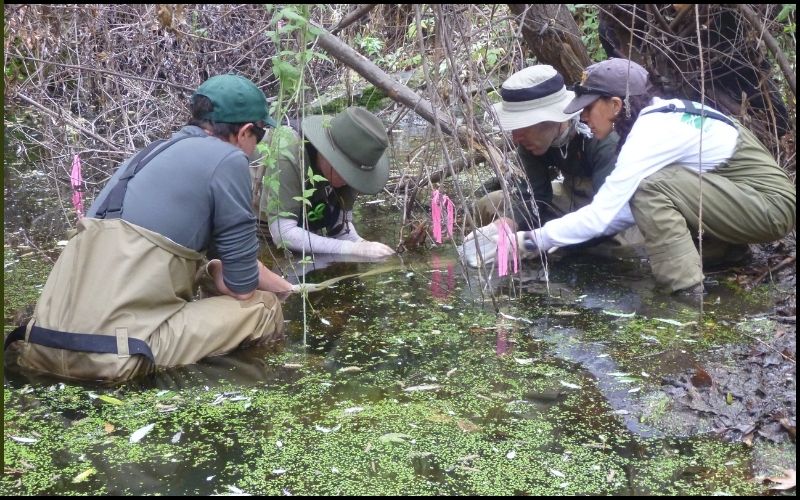
Four people crouching in water holding sampling containers

This two-day course is designed for individuals and/or organizations performing field sampling of environmental media including soil and other solids; surface and groundwater; sediment; indoor and ambient air; solid and hazardous waste; and chemicals of commerce for the analysis of a broad range of analytical methods as established by a variety of regulatory and standards organizations.

Day one will include a full-day in a classroom with lectures discussing sampling methodology and theory; techniques and procedures; health and safety concerns; documentation and deviations; handling and preservation; equipment and supplies; and field quality assurance procedures.

The second day will consist of a half-day of lecture in the classroom discussing issues associated with laboratory techniques and processes, analytical measurement, and data reporting of sample results. The classroom portion will incorporate demonstrations and examples on certain points. The topics discussed are intended to provide an overview of sampling techniques and practices, and details of specific issues will be explored as time permits.

The field portion of the course will take place in the afternoon at a nearby location, and is designed to provide hands-on, practical experience executing some of the concepts reviewed in the classroom lessons. Attendees will apply learned methodology in the field. Equipment and supplies will be provided.

Please dress weather/outdoor appropriate for the field portion of the course. 

"I learned so much in this class. Good information and good pace." Sarah C., June 2017

Intended audience

This course is intended for anyone engaged in the gathering and preparation of field samples for analysis, or anyone who needs to understand more about correct sampling procedures.

CEUs
1.40
Course Topics

Expectations for course completion include student ability to:
• Describe a general sampling approach and provide justification for the proposed methodology
• List general procedures for sampling depending on specific media and methods
• Describe health and safety issues associated with a given sampling approach and procedure
• Describe sample collection and packaging processes for specific media and methods
• Perform chain-of-custody documentation

Course Materials
*Registered attendees will receive a PDF copy of course materials prior to the class. A hard copy may be requested for United States addresses