Chemistry

PFOS, PFAS, PFOA, and Emerging Contaminants
**If this course has Remote Live Attendance -- USA as the location, it is a live stream remote course. You will need a computer and an internet connection.

**If this course has a city and state as the location, we will be attempting to hold the course in-person at the listed location with course times listed in the host city's time zone; however, due to gathering restrictions and health concerns, NWETC reserves the right to convert this course to a live remote streaming course. If you would like more information or have any questions, please contact us via email or phone 425 270 3274. 

In this 2-day PFAS in Groundwater & Emerging Contaminants course you will learn how to apply scientific and legal considerations to sites contaminated with per- and polyfluoroalkyl substances (PFAS). Per- and polyfluoroalkyl substances (PFAS) are a group of man-made chemicals that includes PFOA, PFOS, GenX, and many other chemicals, which are very persistent in the environment and in the human body. There is evidence that exposure to PFAS can lead to adverse human health effects. PFAS have been manufactured and used in a variety of industries around the globe, including in the United States since the 1940s and their chemistry creates unique challenges in water treatment and remediation. The fate, transport, and chemical transformations of most PFAS in the environment are still unknown and are areas of active scientific research.

We will explore the topics of PFOS, PFAS, PFOA, and emerging contaminants related to soil and groundwater remediation.  Over the past few years, several agencies and organizations have released strategies and recommendations related to emerging contaminants.  In general, emerging contaminants are ones for which incomplete toxicity data exists or for which new data has been released.  Emerging contaminants could also be from a new source or have a newly recognized exposure pathway or lower detection limit. 

This workshop will keep you up-to-date on the topic of emerging contaminants and will give you an understanding of how U.S. agencies such as EPA and DOE are working to develop approaches for dealing with emerging contaminants.  We will also discuss the chemical and physical properties of emerging contaminants, how these compare to more traditional contaminants, and how these impact the ultimate fate and transport of these chemicals.

Course Topics
  • Chemistry of PFAS, PFOA, PFOS, GenX
  • Site assessment for the potential presence of PFAS
  • Known and uknown science regarding PFAS
  • PFAS policy
  • Mitigation options such as containment or remediation
Course Materials

Attendees will receive a course workbook containing workshop proceedings and reference material.

What to bring

In person courses will have drinks and snacks provided as current health recommendations allow. Lunch will be on your own.
Course Subject

Comprehensive Environmental Sampling: Methodology, Practice, and Analysis

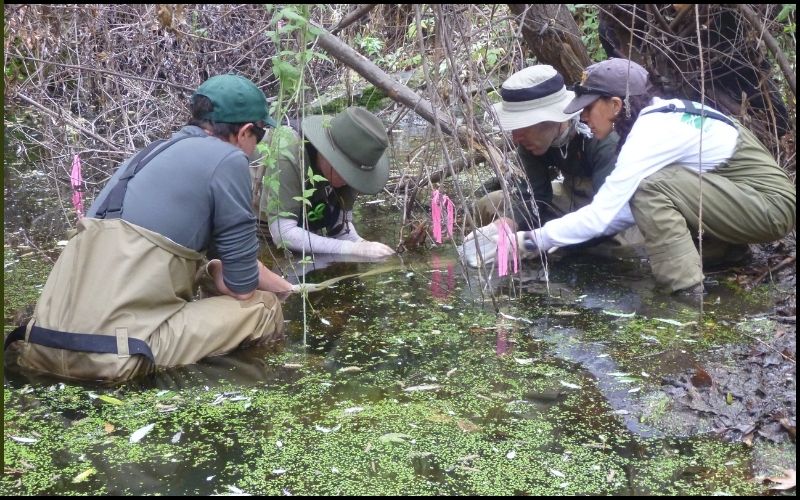
Four people crouching in water holding sampling containers

This two-day course is designed for individuals and/or organizations performing field sampling of environmental media including soil and other solids; surface and groundwater; sediment; indoor and ambient air; solid and hazardous waste; and chemicals of commerce for the analysis of a broad range of analytical methods as established by a variety of regulatory and standards organizations.

Day one will include a full-day in a classroom with lectures discussing sampling methodology and theory; techniques and procedures; health and safety concerns; documentation and deviations; handling and preservation; equipment and supplies; and field quality assurance procedures.

The second day will consist of a half-day of lecture in the classroom discussing issues associated with laboratory techniques and processes, analytical measurement, and data reporting of sample results. The classroom portion will incorporate demonstrations and examples on certain points. The topics discussed are intended to provide an overview of sampling techniques and practices, and details of specific issues will be explored as time permits.

The field portion of the course will take place in the afternoon at a nearby location, and is designed to provide hands-on, practical experience executing some of the concepts reviewed in the classroom lessons. Attendees will apply learned methodology in the field. Equipment and supplies will be provided.

Please dress weather/outdoor appropriate for the field portion of the course. 

"I learned so much in this class. Good information and good pace." Sarah C., June 2017

Intended audience

This course is intended for anyone engaged in the gathering and preparation of field samples for analysis, or anyone who needs to understand more about correct sampling procedures.

CEUs
1.40
Course Topics

Expectations for course completion include student ability to:
• Describe a general sampling approach and provide justification for the proposed methodology
• List general procedures for sampling depending on specific media and methods
• Describe health and safety issues associated with a given sampling approach and procedure
• Describe sample collection and packaging processes for specific media and methods
• Perform chain-of-custody documentation

Course Materials
*Registered attendees will receive a PDF copy of course materials prior to the class. A hard copy may be requested for United States addresses
Course Subject

Environmental Forensics-Site Characterization and Remediation

Two scientists in protective gear taking samples

**Note - For every course we have implemented live stream remote attendance.  You will need a computer and an internet connection.  

If you would like more information or have any questions, please contact us via email or phone 425 270 3274.  


This 2 day course will provide attendees with a wide array of analytical techniques available to fingerprint a variety of contaminants and to address the basic questions involved in any environmental forensics study:

1. What is the contaminant(s)?

2. What is the source(s)?

3. When did the release occur?

4. Is the contaminant degrading?

In addition, there will be a discussion of why certain techniques are more appropriate than others, the problems that may be encountered when interpreting results, and what to do if there are no unique answers to some of the above questions. Examples will be provided from a variety of environmental forensic investigations involving a range of contaminants and different issues that have been encountered.

Attendees will learn the range of supporting methods used into order to prepare the strongest case possible when presenting findings.

The final topic will center around site remediation and how some of the techniques used in topics discussed above can also be used to monitor site cleanup, particularly those sites being remediated by natural attenuation.

This course is certified by Texas Commission on Environmental Quality (TCEQ) for 14 hours of continuing education credit.

Intended audience

This course will provide useful information for chemists, engineers, geologists, hydrogeologists, microbiologists, attorneys and regulators that are involved with a variety of environmental issues including contamination characterization and source determination as well as site remediation

CEUs
1.40
Course Topics
  • Environmental Forensics-Past and Present
  • Initial characterization of the site-groundwater flow, oxicity, salinity
  • Information needed for a successful investigation
  • Classes of Contaminants to be discussed
  • The tiered fingerprinting approach
  • Inorganic contributions to fingerprinting
  • Additional information required for successful environmental investigations
  • Age dating of contaminants-successful and unsuccessful techniques-including presence or absence of certain compounds, atmospheric contaminants, radioactive isotopes, tree-ring dating
  • Monitoring site remediation-most appropriate techniques.
  • Natural attenuation
  • Case Histories
  • State specific cases
Course Materials

*Registered attendees will receive a PDF copy of course materials prior to the class. A hard copy may be requested for United States addresses.

What to bring

You will need a computer with an internet connection. You may wish to have your text available and pencil and paper to take notes.

Course Subject

Fundamental Contaminant Chemistry in Soil and Groundwater

**If this course has Remote Live Attendance -- USA as the location, it is a live stream remote course. You will need a computer and an internet connection. 

**If this course has a city and state as the location, we will be attempting to hold the course in-person at the listed location with course times listed in the host city's time zone; however, due to gathering restrictions and health concerns, NWETC reserves the right to convert this course to a live remote streaming course. If you would like more information or have any questions, please contact us via email or phone 425 270 3274. 

Note: Course image above is of the Berkeley Pitt in Butte Montana where the groundwater is exposed due to past mining operations from what is one of the largest superfund sites in the country. Photo Credit: Pamela Schultz

* Also, see our companion course "PFOS, PFAS, PFOA, and Emerging Contaminants". 

This two-day course includes an overview of key chemistry concepts associated with environmental contamination and provides a foundation for understanding contaminant fate and transport. The concepts discussed are essential for understanding soil and groundwater contamination along with the selection of appropriate remediation approaches.

The course begins with a review of basic chemistry concepts that are built upon as more complex topics are introduced. The first day includes a fundamental chemistry overview, covering chemical structure, properties, and reactions for metals and organic chemicals.  On the second day, characteristics of subsurface systems are discussed along with detailed descriptions of contaminant transport and degradation mechanisms.

A key goal of the class is for participants to become comfortable with the terminology and parameters used in environment chemistry and contaminant transport literature and studies. Concepts are illustrated using examples and historical context. For some examples, participants will use calculators. Spreadsheet models are provided to those interested in using simplified contaminant transport models. Major uncertainties and limitations of modeling approaches will also be discussed.

"Excellent speaker, very intense knowledge and passionate for the subject material.  Great Job!"- J. Collins, April 2013, Helena, MT

"Pamela obviously has a lot of knowledge and experience in this field.  She answered questions to the best of her abilities, and presented interesting information.  She was easy to follow and understand."  - H. Zrucky, April 2013, Anchorage, AK

"The course had a very logical progression with the necessary chemistry refresher which was fairy comprehensive and provided a base for the groundwater concepts to follow."- J. Akielaszek, September 2013, Albany, NY

"I have not taken a chemistry course for 16 years and the instructor did an excellent job of explaining concepts applicable to my profession." 
- J. Sawetz, November 2013, Bellevue, WA


Intended audience

This class is extremely useful for anyone looking to update, expand, and refresh their knowledge of environmental chemistry in relation to soil and groundwater contaminants.  The course material will greatly enhance on-the-job training and is also recommended for project managers seeking a more thorough understanding of contaminant behavior.  This subject matter is useful for scientists and engineers who would like to better understand contaminant fate and transport and provides a solid understanding of why certain contaminants are especially recalcitrant and difficult to remediate.  This understanding will guide professionals when evaluating remedial options for contaminated sites.

Prerequisites

Some college level chemistry is required (even if it was a long time ago).

CEUs
1.30
Course Topics

Part 1:  Chemical Structure.  This section covers chemical structure from atomic to molecular scale. Concepts of polarity and electronegativity are introduced and interactions between molecules are discussed. The basic rules of chemical nomenclature are also reviewed.


Part 2:  Chemical Properties.  Several chemical properties are introduced that are relevant to chemical fate such as solubility and partitioning coefficients. Sources of data are discussed along with uncertainties.


Part 3:  Chemical Contaminants.  Major contaminant groups are discussed including metals and organic compounds. The relationship between metal speciation and properties is illustrated through example. Chemical structures for organic molecules are reviewed. The interplay between structure and properties is highlighted throughout.


Part 4:  Chemical Reactions.   This section introduces the concepts of chemical reactions and products.  Acid-base and oxidation-reduction reactions are discussed in detail.  The concepts of pH and pE are explained.  Dissolution and partitioning reactions are also discussed.


Part 5:  Characteristics of Subsurface Systems.  The purpose of this section is to understand the meaning and magnitude of subsurface parameters required by groundwater contaminant transport models. Properties of subsurface systems and their impact on chemical transport are discussed.


Part 6:  Contaminant Transport.  Phenomena are discussed that influence the movement and fate of dissolved phase contaminants in groundwater. The impact of advection, dispersion, sorption, and chemical reactions are discussed in an incremental fashion.


Part 7:  Nonaqueous Phase Liquids.  In this section, the movement and dissolution of nonaqueous phase liquids (NAPLs) is explained. Relevant fluid properties such as interfacial tension are explained. Single and multicomponent NAPLs are discussed.  


Part 8:  Hydrocarbons.  This section discusses mixtures of hydrocarbons in more detail such as gasoline and diesel fuel. Biodegradation mechanisms are discussed along with geochemical indicators of degradation and natural attenuation.


Part 9:  Chlorinated Hydrocarbons. Chlorinated compounds are discussed in more detail with a focus on chlorinated solvents such as tetrachloroethene (PCE) and trichoroethene (TCE). Degradation mechanisms are discussed along with geochemical indicators of degradation.


Part 10:  Metals.  Metal contamination is discussed in more detail.  In particular, the influence of pH and pE on metals is further illustrated.


Course Materials

*Registered attendees will receive a PDF copy of course materials prior to the class. A hard copy may be requested for United States addresses. If course is in-person, note that you must bring a device to view the PDF to class.

What to bring

Please bring a calculator (a calculator app on a smartphone is acceptable.) For in person courses, bring a pen or pencil, coffee mug, and a water bottle. Drinks and snacks will be provided each day. Lunch will be on your own. Note that you must bring a device to view the PDF to class.

Course Subject

Collecting and Handling of Water Samples for Trace Metal Analysis

This course is designed for anyone collecting ambient water samples for the analysis of low-level total and dissolved mercury and other trace metals, as well as various metals species (including methylmercury and inorganic arsenic species). This one-day course will include a half-day in a classroom with lectures covering the circumstances in which low-level detection limits would be desired or required, EPA analytical methods that must be used, proper handling and preservation of samples, necessary sampling supplies, considerations that should be made prior to and during sampling activities in order to collect samples correctly and avoid contamination, various sampling and field-filtration techniques, and field quality assurance sample collection requirements.*

The second half of the day, students will engage in hands-on field exercises, where they will be given the opportunity to practice several surface water sampling protocols using various sample collection methods and following the “Clean Hands/Dirty Hands sampling techniques. Time permitting, sample collection techniques and recommendations for additional sample matrices may be discussed that are specific to the student’s needs and area of interest. See the “Course Topics” area below for topic list.                          

Please wait to receive a course confirmation email, roughly one month prior to the class, before making any travel arrangements.

Intended audience

This course is intended for supervisors, field sampling staff, wastewater treatment facility staff, consultants, engineers and students interested in successfully sampling wastewater influents/effluents, stormwater and ambient receiving waters for mercury and metals at EPA and State discharge and water quality criteria level.

CEUs
0.70
Course Topics
  • Why the Need for Low-Level Metals Detection? Reasons why low-level metals detection and EPA Sample Collection Method 1669 is desired and becoming required. A brief discussion regarding the Clean Water Act, Total Maximum Daily Loads, and drivers for low-level detection.
  • EPA 1600 Series Methods: Various EPA Analytical Methods (1600-series) available for trace metals analysis. Instruction will also be provided for proper handling and preservation of samples prior to or immediately following laboratory receipt.
  • Sampling Supplies & Equipment: The correct equipment and supplies that MUST be used in order to successfully collect a water sample for trace-level metals analysis. Surface and subsurface sampling supplies will be discussed, including equipment needed for proper field filtration.
  • Considerations Before & During Sample Collection: In order to obtain credible and scientifically defensible data, considerations should be made before and during sample collection. The instructor will discuss what should be included in a sample analysis plan when collecting ambient water quality samples for low-level metals analysis. Participants will gain an understanding of different sources of contamination or interferences that can cause problems with trace metals analysis and ways to avoid contamination.
  • Clean Hands/Dirty Hands Sampling Technique: EPA Method 1669 “Clean Hands/Dirty Hands” for several different sampling methods and a practical demonstration.
Course Materials
Attendees will receive a course manual containing workshop proceedings and reference material.
What to bring

Please bring a pen or pencil, and notepad if you would like to take notes (you may also choose to take notes in your book). Please be aware that the field/sampling portion of the course will entail walking through park grounds, and being around/near water. Please dress appropriately for the outdoor/field portion of the course (closed-toe shoes, etc.)


Course Subject