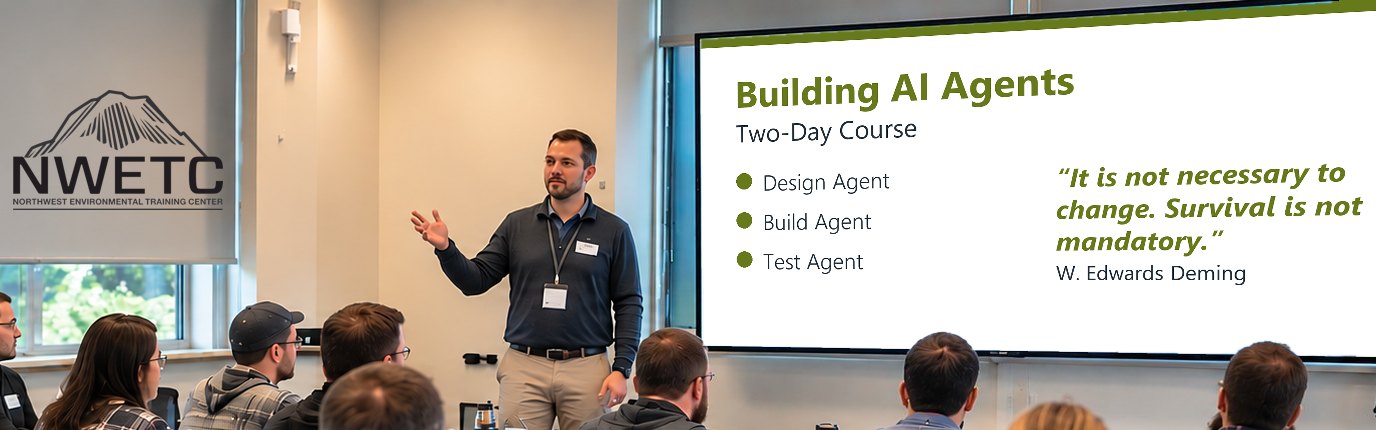
Building AI Agents
AI-103
Design, Test & Supervise
What you'll find out
What is an AI agent, when do I need one, and how do I design, build and test one I can supervise?
- Design AgentIts job · Its access · Your OK
- Build AgentSmall trial · Watch each run
- Test AgentBreak it · Fix it · Decide
Crawl, Walk, Run. Design first, build small, test hard. You may run in one area and crawl in another. It's a loop, not a ladder.
Across the course
- You stay in chargeA named person owns every step that matters.
- Only the access it needsConnect only what the job needs.
- What it reads isn't an orderEmails, documents and pages it reads are information, not commands.
- Tested before you rely on itCheck the answer and how it got there, then decide go or stop.
- Work others can checkPlans, run records and how-tos that work in any AI tool.
- It's a grindExpect wins, misses and light-bulb moments, often in the same session. Every miss teaches you something.
What you'll have the opportunity to build
- Agent or not? A quick check for any task
- Agent plan: its job, access and sign-offs
- Map of what it can see and send
- Small trial agent + a record of each run
- Test plan + your go-or-stop call
How you'll learn
Hands-on from the start: you design, build and test a real agent on material we provide, with instructors who build agents in their own work.
You decide what happens to every AI result: accept it, verify it against the source, reject it if unsupported, or escalate it to an expert.
An agent is only as good as your instructions.
Add responsibilities as the agent earns your confidence.
Since mid-2024, NWETC has changed its ways of working by incorporating AI tools. We earned that expertise the hard way, through constant practice, success and failure, and every class gives you hands-on time applying AI tools in your professional role.
Course details
You want AI to handle a task with several steps, not just answer a question, while you stay in charge.
Prompt & Context Engineering or similar. No coding needed.
- How AI Agents Work: What an agent does, where you already use one, and when a set routine does the job better.
Covers: An agent acts; a chat answers · It picks, does, checks · What it can see and use · Chat, set routine or agent? · What it reads isn't an order
Practice + build: Pick the right tool for each task · Watch an agent work, step by step · Find the hidden instruction in a document - Designing an Agent: Decide its job, what it can reach, and which steps you sign off on.
Covers: Its job, its limits, when it's done · Only the access the job needs · Which steps you approve first · Costlier mistake, more check-ins
Practice + build: Fill in an agent plan · Trim what it can reach · Set when it stops and asks · AI reviews your plan - Building & Running a Trial: Build a small agent that drafts but doesn't send; check each run and improve it.
Covers: Build it without code, with clear rules · What it's allowed to change · It waits for your OK · A record of each run + a how-to
Practice + build: Let it draft; you review · Find, fix, re-test · Approve or send it back - Testing & the Go-or-Stop Call: Test it, try to trick it, plan for mistakes; then use it, limit it, fix it or stop.
Covers: Decide what “good enough” means · Check the steps, not just the answer · Try to trick it on purpose · More than one check
Practice + build: Trick your trial agent · Ask IT what limits they can set · Make the go-or-stop call
Computer with internet access